 Pay Securely

Heat Exchanger vs. Dual Boiler: Choosing the Right Espresso Machine for Your Daily Routine
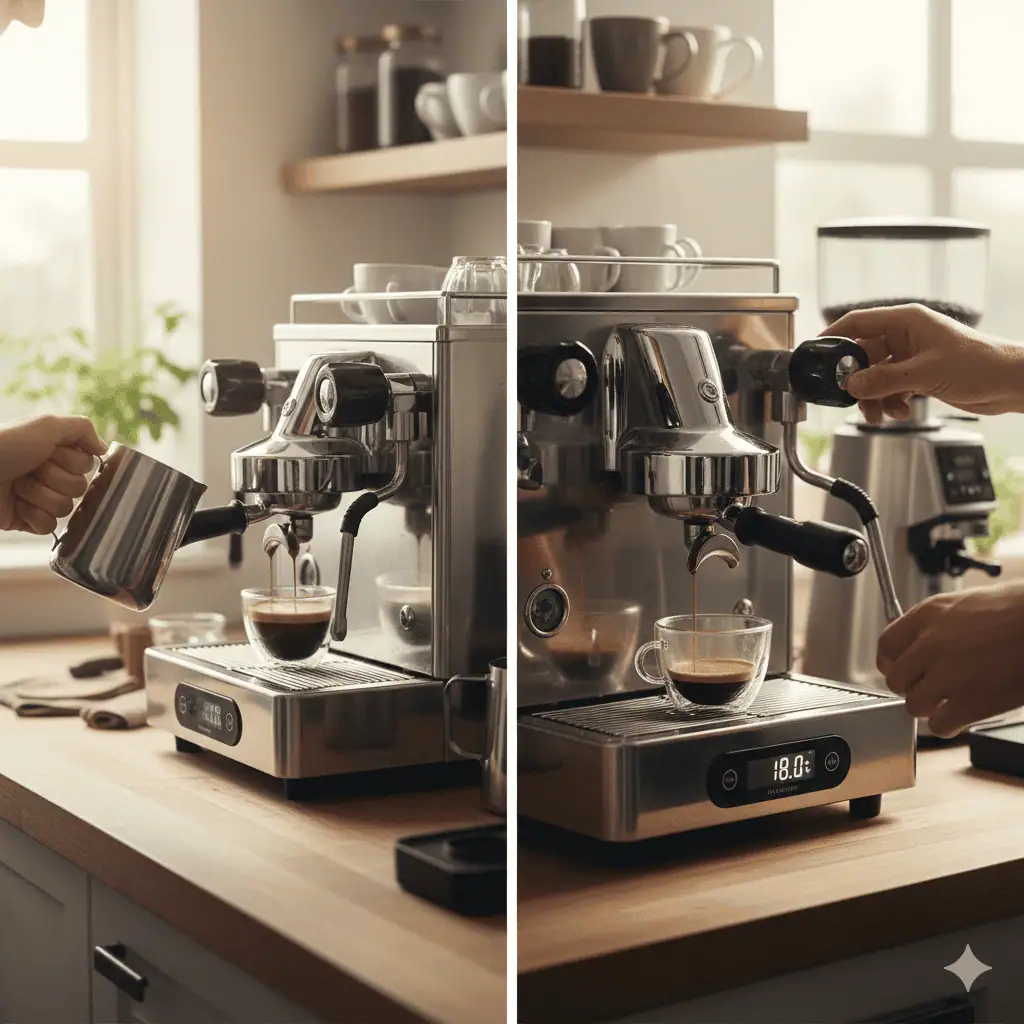
Introduction Hook: You’ve moved past entry-level—now you face the critical choice between HX and DB. This guide breaks down the core functional difference (simultaneous steaming/brewing) and helps the reader match the technology to their specific kitchen workflow and skill level.
The Fundamental Difference: How They Manage Temperature
Use this section to explain the mechanics simply.
Heat Exchanger (HX):
Mechanism: One large boiler for steam, with a tube (the heat exchanger) running through it to heat the brew water on demand.
Pros: Lower cost, simultaneous milk steaming and brewing, faster recovery.
Cons: Requires a “cooling flush” before pulling a shot to stabilize brew temperature (a learned skill). Less precise temperature control than a DB.
Dual Boiler (DB):
Mechanism: Two separate, dedicated boilers (one for steam, one for brewing).
Pros: Perfect, consistent temperature control for the brew water (often PID-controlled). No cooling flushes needed. Ideal for espresso purists.
Cons: Higher price point, slower warm-up time, consumes more electricity.
Workflow: Matching the Machine to Your Habits
This section is the decision matrix for the reader.
| Scenario | Best Choice | Rationale |
| The Latte Artist | Heat Exchanger (HX) | The priority is fast, consistent steam power and quick lattes. The cooling flush is a quick habit to learn. |
| The Espresso Purist | Dual Boiler (DB) | The priority is precise temperature (PID) for the best single-origin espresso. Shots are pulled without having to manage temperature. |
| The Weekend Host | Dual Boiler (DB) | DBs maintain steam and brew capacity better for quickly serving 4-6 drinks back-to-back. |
| The Morning Solo Drinker | Heat Exchanger (HX) | Quick to heat up and simple to use for one person’s quick morning routine. |